
Chief Investment Officer | Principal


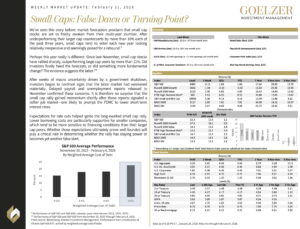 We’ve seen this story before: market forecasters proclaim that small cap stocks are set to finally awaken from their multi-year slumber. After underperforming their larger cap counterparts by more than 10% each of the past three years, small caps tend to enter each new year looking relatively inexpensive and seemingly poised for a rebound.*
Perhaps this year really is different. Since late November, small cap stocks have rallied sharply, outperforming large cap peers by more than 11%. Did investors finally heed the forecasts, or did something more fundamental change? The evidence suggests the latter.**
After weeks of macro uncertainty driven by a government shutdown, investors began to confront signs that the labor market had weakened materially. Delayed payroll and unemployment reports released in November confirmed those concerns. It is therefore no surprise that the small cap rally gained momentum shortly after those reports signaled a softer job market—one likely to prompt the FOMC to lower short-term interest rates.
Expectations for rate cuts helped ignite the long-awaited small cap rally. Lower borrowing costs are particularly supportive for smaller companies, which tend to be more sensitive to financing conditions than their larger cap peers. Whether those expectations ultimately prove well-founded will play a critical role in determining whether the rally has staying power or becomes yet another false start.
* Performance of S&P 500 and S&P 600, calendar year total returns (2023, 2024, 2025).
** Performance of S&P 500 and S&P 600 from November 20, 2025 through February 9, 2026.
Weekly Market Update: February 11, 2026
