
Chief Investment Officer | Principal


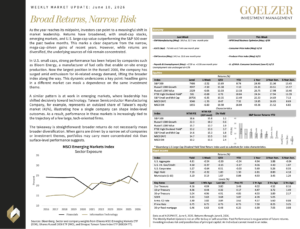 As the year reaches its midpoint, investors can point to a meaningful shift in market leadership. Returns have broadened, with small-cap stocks, emerging markets, and U.S. large-cap value outperforming the S&P 500 over the past twelve months. This marks a clear departure from the narrow, mega-cap–driven gains of recent years. However, while returns are diversified, the underlying sources of risk remain concentrated.
In U.S. small caps, strong performance has been helped by companies such as Bloom Energy, a manufacturer of fuel cells that enable on-site energy production. Now the largest position in the Russell 2000, the company has surged amid enthusiasm for AI-related energy demand, lifting the broader index along the way. This dynamic underscores a key point: headline gains in a different market can mask a dependence on the same investment theme.
A similar pattern is at work in emerging markets, where leadership has shifted decisively toward technology. Taiwan Semiconductor Manufacturing Company, for example, represents an outsized share of Taiwan’s equity market (41%), illustrating how a single company can shape index-level outcomes. As a result, performance in these markets is increasingly tied to the trajectory of a few large, tech-oriented firms.
The takeaway is straightforward: broader returns do not necessarily mean broader diversification. When gains are driven by a narrow set of companies or investment themes, portfolios may carry more concentrated risk than surface-level performance suggests.
Weekly Market Update: June 10, 2026
