
Chief Investment Officer | Principal


 “Every stock seems to be a biotech stock”—as one colleague recently put it—reflecting the outsized price moves following earnings announcements. The point wasn’t that every company suddenly belonged to biotech, but that many stocks were exhibiting biotech-like volatility, particularly in the immediate aftermath of earnings. What could be driving this behavior?
A straightforward explanation is that elevated market levels have raised the bar. After a sustained run to all-time highs, companies must deliver not just solid results, but also strong guidance to justify valuations. Even modest disappointments can trigger sharp price reactions.
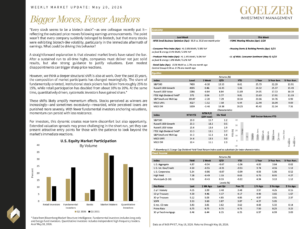
However, we think a deeper structural shift is also at work. Over the past 15 years, the composition of market participants has changed meaningfully. The share of fundamentally oriented, institutional stock pickers has fallen from roughly 25% to 15%, while retail participation has doubled from about 10% to 20%. At the same time, quantitatively driven, systematic investors have gained share.*
These shifts likely amplify momentum effects. Stocks perceived as winners are increasingly—and sometimes excessively—rewarded, while perceived losers are punished more severely. With fewer fundamental investors anchoring valuations, momentum can persist with less resistance.
For investors, this dynamic creates near-term discomfort but also opportunity. Extended valuation spreads may prove challenging in the short run, yet they can present attractive entry points for those with the patience to look beyond the market’s immediate reactions.
* Data from Bloomberg Market Structure Intelligence. Fundamental investors includes long-only and hedge-fund investors. Quantitative investors includes independent high-frequency traders. As of May 18, 2026.
Weekly Market Update: May 20, 2026
